The spectator is sitting in a red room, a voice improvises on the fluctuations curves of the Nikkei index and other stock exchange datas.
M.G.: You also explore all these invisible forces or these elusive specters in situations whose reality is as overwhelming as it is incomprehensible, as in Indice Nikkei [fig. 6 + p. 193–196]. What is the story behind that piece?
N.N.: The first version of Indice Nikkei was made in 2003 for my solo show “Haus / raus-aus” at Le Plateau – FRAC Île-de-France. At the time it seemed to me that the stock exchange and the financial systems were at the heart of our fragility, a fragility in the sense of an opaque world that we as citizens could not grasp, understand or therefore influence, if only by the power of thought. Ten years later, this analysis has become a cliché and the “crisis” of 2008 marked a new stage in our perception of the idea of catastrophe. The piece’s structure, built around echoes, and the walls painted red and the chalk on the walls—these are ways of staging the effects of saturation and dizziness produced, among other things, by a deep feeling of impotence. The curves are astonishingly similar to the fractures in the rock in Kurihara Mountain after the earthquake of 2008. The forms of these curves were later “interpreted” as an act of resistance by the soprano Donatienne Michel-Dansac, whom I invited to take part in the project.
M.G.: This element of the unknown, whether the mystery that characterizes Andrea or the opacity of financial systems in Indice Nikkei, seems to take other forms in e and f.
Exhibitions :
2003 Haus/raus-aus, Le plateau-Frac ïle de France, Paris FR
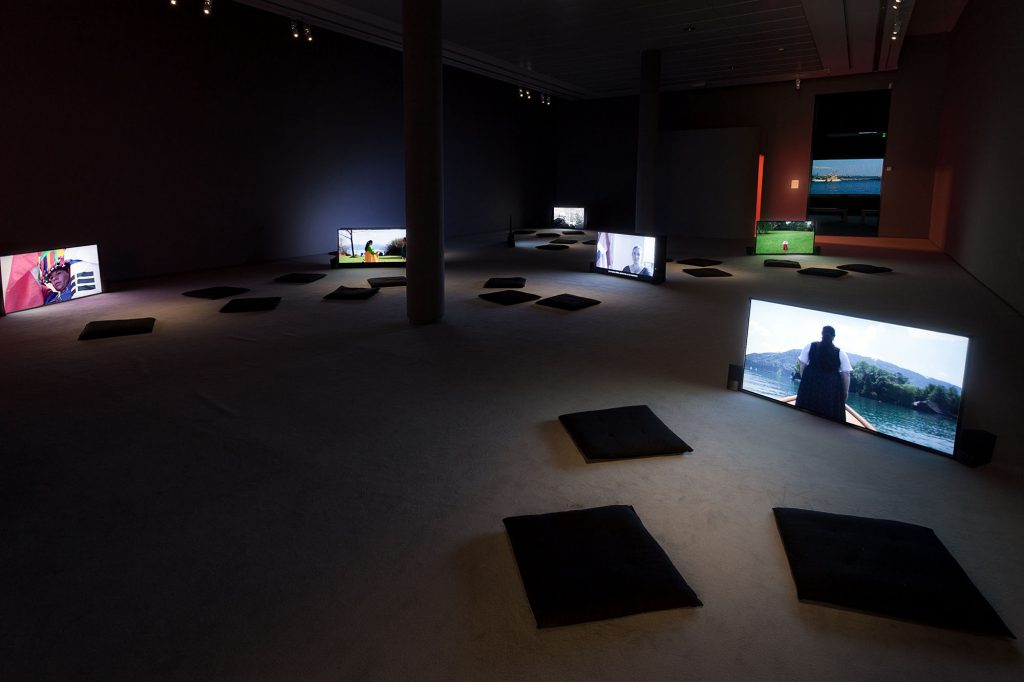
2013-14 Echo, Jeu de Paume, Paris FR
Excerpt from the Interview with Marta Gili, In Catalogue “Echo”, Jeu de paume, Actes Sud, 2014