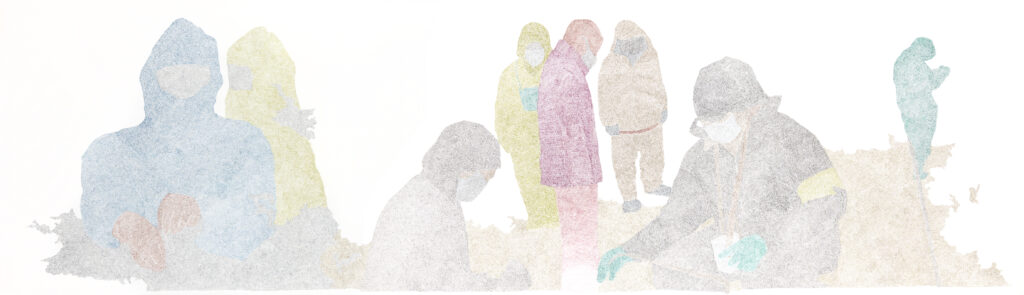
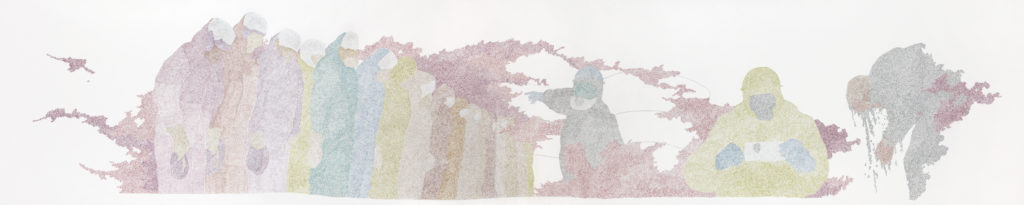
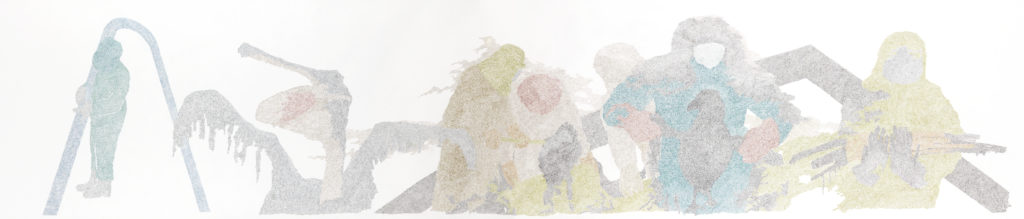
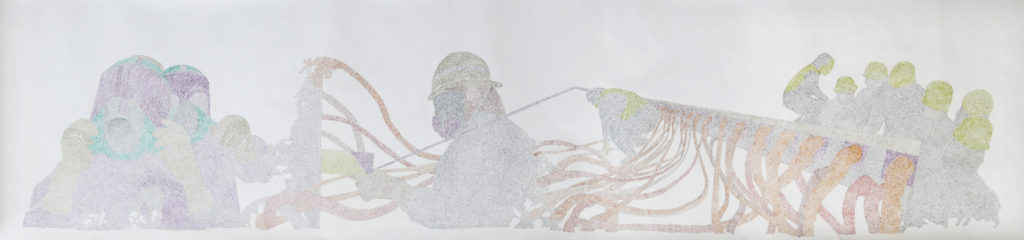
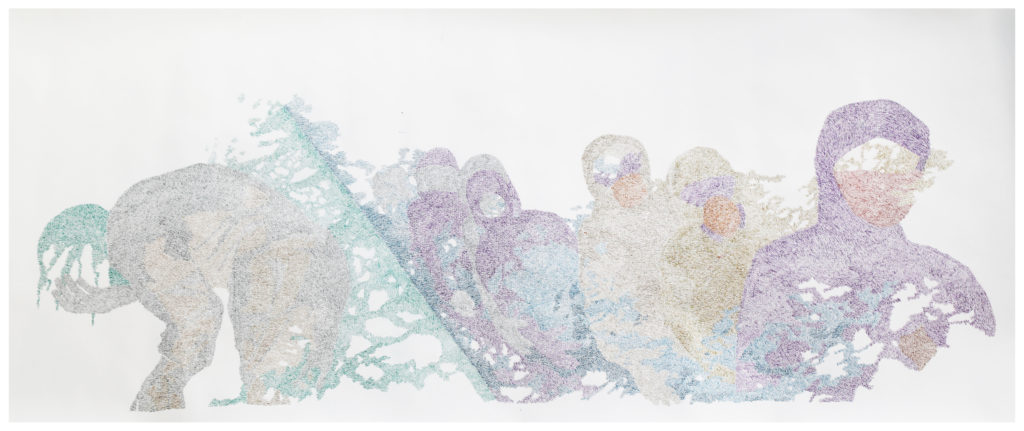
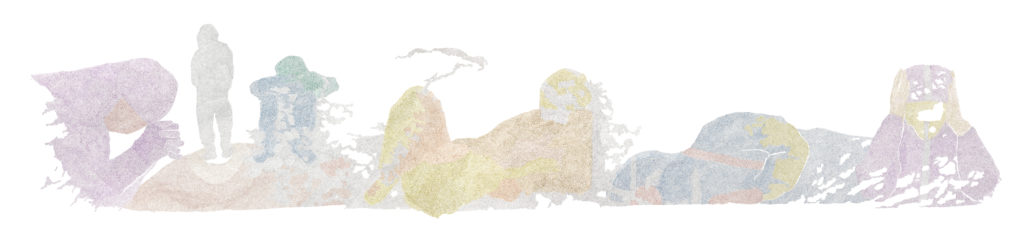
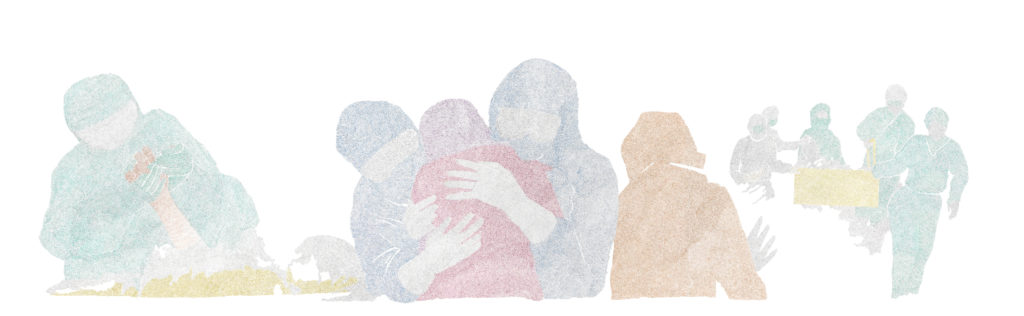
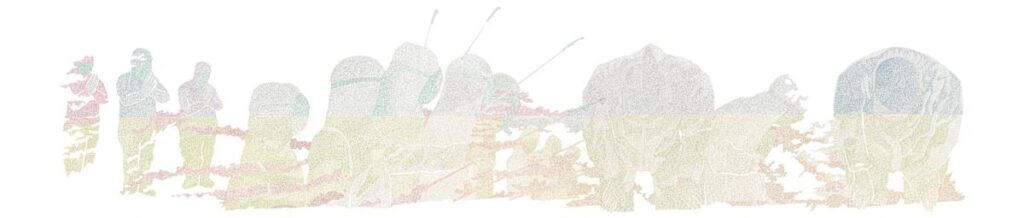
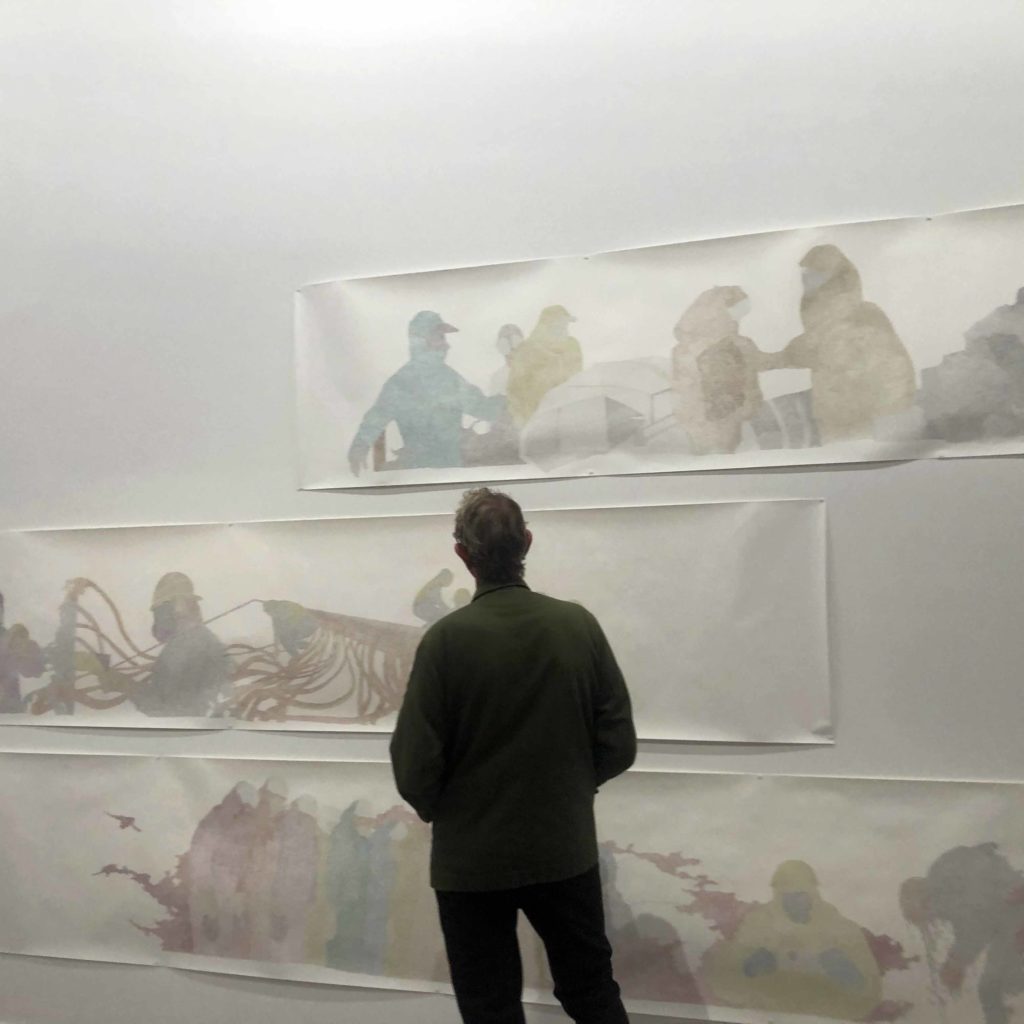
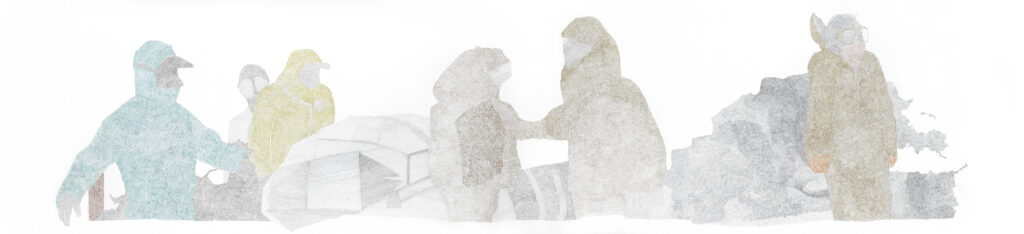
The drawings are guided by mental images as much as reference images taken from the media. The faceless bodies and identities of the men and women who saved us haunted the canvas long after the events. A silent, invisible and anonymous mass, they represented the only possible images of redemption, highlighting the paradox that care, rendered anonymous, is almost inhuman. These images then spread from crisis to crisis: that of the Corona virus in particular, then those of the wars, in the rubble of Kiev, Kibbutz Re’im or the ruins of Gaza. Without transition, the drawings have been continuously fed with these images, the ghosts have invaded our daily lives, and the series, which began in 2012, has continued for more than ten years, like a filter of time that has irradiated our lives.
“Under the gold of their bodies, therefore, rot was at work. A whole people was doomed to extinction, a measureless catastrophe for beings who could now exist only in the imagination. The first time I saw it, Natacha Nisic’s drawing reminded me of the title of that Gauguin painting, And the Gold of Their Bodies. Was it the sense of a similar decay at work behind the immaculate exterior? An immediate relation between the subjacency of an invisible evil and a representation devoid of direct violence ?
Or the gold, the gold of their bodies, bodies that are also unhistorical, abstract,and This drawing is associated with the title of a painting that is over a century older, but in addition, by objective chance, the title of the earlier work is intimately linked to the contents of the later one: it is, then, a matter of refraction, of the deviated gaze, or even of the untimely refraction of one work through another: resonance or constellation, hospitality or foreign body.
An encounter, in any case. On strong, immaculate white Canson paper, worked on as a roll – the vision of the drawing being executed was thus always sectioned, fragmentary, masked by the paper as it wrapped back over itself – remain only scant marks sketched in pencil: general forms, contours partially erased, corrections here or there. These sketchy forms are the only lines that continue the drawing, the only slender (and soon to disappear) lines, for the drawing itself is made up only of striations and creases, of marks no sooner begun than suspended, stick drawings you might say,not touches, but the scrupulous marks of the pencil returning regularly over the sheet in a beat or pulse, the scattering of parallel traces organized in successive zones and laid out to a changeless, implacable rhythm, propagating and contaminating with its marks the whole expanse assigned to the motif.
This texture with no backing other than the white of the paper, a texture without a weft, therefore, like something floating or emerging, the vibration of a shimmer, is distinctive in that it is made exclusively with luminescent metal pencils amidst the darkness – like fireflies, which are also luminescent. In the box of twelve pencils, pewter, copper, and silver sit with gold and antique gold. It was the use of the latter that prompted the association with And the Gold of Their Bodies.”
Florent Perrier – « And the Gold of Their Bodies – Refractions of Fukushima »