English Translation :
Natacha NisicInterview with Julia Garimorth
Julia Garimorth: The Fukushima nuclear accident inspired a series of drawings…
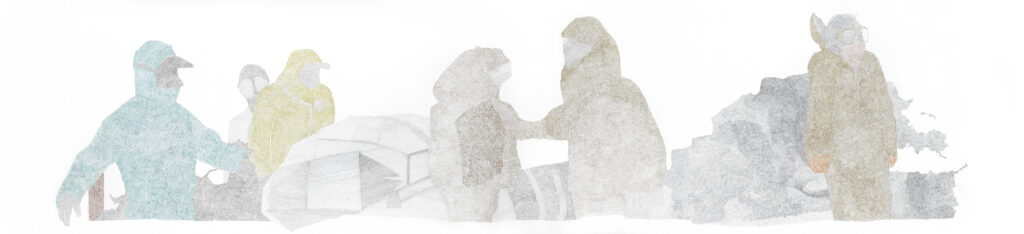
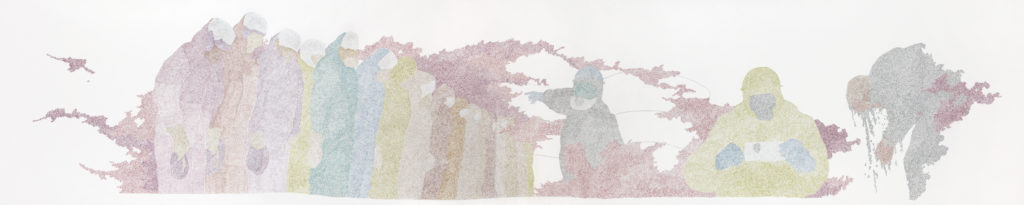
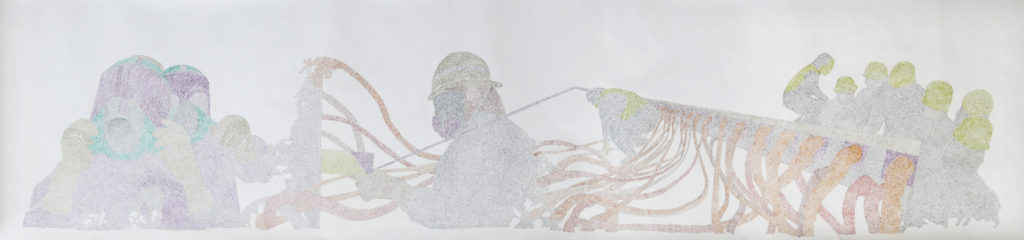
Natacha Nisic: I traveled to the outskirts of the Fukushima Daiichi nuclear power plant in 2013. A perimeter of over 30 kilometers closed off access to it. We moved around wearing masks, accompanied by a Geiger counter, our sonic lookout,whose intensity and speed varied according to the millisieverts. Along the coast, the villages were destroyed, revealing the traces of the deadly tsunami; further inland, entire towns were deserted, abandoned by residents who had been forced to leave everything behind, cornered by an invisible threat. Men in protective suits paced the roadsides and wooded areas; like industrious ghosts, they gathered the soil and placed it into garbage bags, which they stacked out in the open.Mountains of plastic were erected to deal with the disaster.
At the time, I had come to make a video, a response to the scale of the devastation caused by the earthquake, the tsunami,and also the radioactivity. Back in France, I tried to establish an intimate narrative stemming from the radioactive danger—insidious, internal, and immaterial. Drawing, as a repetitive gesture, imposed itself upon me, as if my future, or that of humanity since the bomb dropped on Hiroshima, were subject to new rules, caught between freedom, fascination, and mortal danger. I bought twelve iridescent pencils, a fixed color spectrum that I stuck to [→ p. 317]. Mental images, as much as reference images gleaned from the media, guided me. Those faceless, identity-less bodies that were saving us haunted me.
J.G.: How did the project En temps réel (In Real Time), a film shot inside a nuclear power plant, subsequently come about?
N.N.: A few years after the Fukushima crisis, I decided to return to the places of my childhood, in the Rhône Valley. I remembered the feeling of danger, mixed with curiosity, when the construction of a power plant was announced less than a kilometer from the school I attended. Twenty years later, the small town, once one of the poorest in France, had become charming and well-kept. The power plant had its effect, bringing a comfortable standard of living: an irradiation of happiness.
I needed to perform a magical gesture: to enter the plant, to get as close as possible to the danger, to rub shoulders with the heart of what is most secret, most harmful, most frightening.
J.G.: How did this approach translate in concrete terms?
N.N.: I didn’t go alone; I was accompanied by a sound engineer and a flutist. We walked through the premises guided by communications officers, looking only at what we were supposed to look at. How do you contain your fear? We submitted to the safety rituals, the multiple steps of dressing and screening, and suppressed feelings of suffocation upon arriving in front of the cooling pools: the noise of the blowers, the anonymous figures in suits passing by us, the sleeping water,chilled, motionless, turquoise; at the bottom, regular dots—the reactor.
J.G.: So you literally “lived” inside the power plant. Can you describe that experience?
N.N.: We tried our own rituals, recording flute pieces in the authorized areas. Futile gestures: the sound of the flute was drowned out by that of the machinery. We were petrified, and yet, all around us, an atmosphere of perfect harmony reigned: people smiled at us in the offices, everyone spoke of their work with enthusiasm. I understood that this was a defensive tactic: when harmony reigns, every intruder is detected. After two weeks, we had adopted the code.
J.G.: And then?
N.N.: Then the doors closed and never reopened, despite three years of numerous attempts—but I am still trying.